




Trommel vs. Rotary Scrubber: Choosing the Right Wash Plant for Clay-Heavy Alluvial Gold
In alluvial and placer gold mining, the presence of clay is the ultimate enemy of high recovery rates. If your gravel contains sticky, high-plasticity clay, it will act like a sponge, wrapping around fine gold particles and carrying them straight out to the tailings pile. This phenomenon, known as "robber gold," can cost mining operators thousands of dollars in lost revenue every single day.
To break the clay-gold bond, you need a robust wash plant. The two most common and effective machines for this job are the Trommel Screen and the Rotary Scrubber. But which one is right for your specific mining site?
In this comprehensive guide, we will break down the mechanics, pros, cons, and ROI implications of Trommels vs. Rotary Scrubbers, helping you make an informed equipment selection for your heavy mineral sand (HMS) and alluvial gold operations.
1. Why Clay is a Nightmare in Placer Gold Processing
Before diving into the equipment, we must understand the problem. In alluvial deposits, gold is often mixed with laterite soils, riverbeds, and weathered rocks. When exposed to water, clay becomes incredibly cohesive. It forms clay balls (often called "mud balls") that:
- Blind Sieve Meshes: Clogging screens and preventing undersize material (where the gold is) from passing through to the concentration stage.
- Trap Fine Gold: Gold particles get stuck inside the clay matrix. If the clay isn't dissolved into a slurry, the gold simply washes away over the sluice box or jig.
- Increase Water Consumption: Thick mud requires massive amounts of pressurized water to break apart.
The primary goal of any initial wash plant is liberation—washing the rocks and gravel clean so that 100% of the heavy minerals are released into the slurry.
2. What is a Trommel Screen?
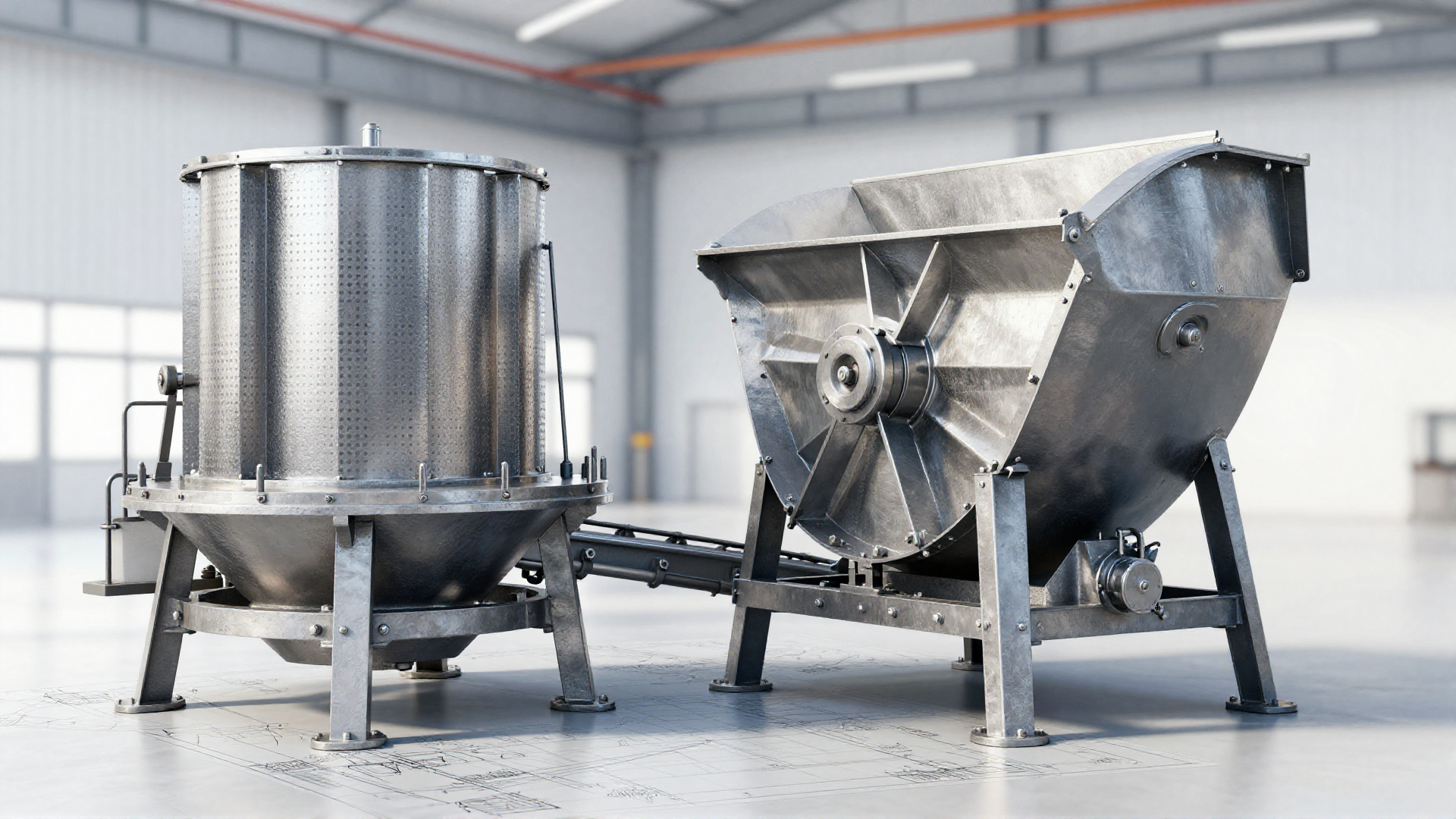
A Trommel Screen (or rotary screen) is a cylindrical drum featuring perforated plates or woven wire screens. It rotates at a relatively slow speed, tumbling the raw ore as high-pressure water sprays from inside the drum.
How it Works:
As the material moves down the slightly inclined rotating drum, the water jets and the tumbling action break up loose dirt and light clay. The finer material (containing the gold) falls through the screen holes into a collection hopper, while the oversized, barren rocks (oversize tailings) are discharged at the end of the drum.
Advantages of a Trommel:
- Excellent Classification: It simultaneously washes and sizes the material.
- Low Power Consumption: It requires less energy compared to heavy-duty scrubbers.
- Cost-Effective: Lower initial CAPEX, making it ideal for Artisanal and Small-Scale Gold Mining (ASGM).
- Simple Maintenance: Changing screen panels is straightforward.
Limitations:
- Poor for Heavy Clay: If your ore has more than 15-20% sticky clay, a standard trommel will struggle. The clay will form balls that roll right through the drum, carrying your gold with them.
 3. What is a Rotary Scrubber?
A Rotary Scrubber (also known as a drum scrubber) is designed specifically for washing tough, sticky ores. Unlike a Trommel, the main body of a scrubber is a solid steel cylinder (no screen holes in the washing section) lined with thick rubber or steel lifter bars.
How it Works:
Raw ore and a large volume of water are fed into the solid drum. As the drum rotates, the internal lifter bars pick up the rocks and clay and drop them. This creates a severe cascading, milling, and grinding action (autogenous grinding). The rocks inside act as grinding media to smash the clay balls apart. The retention time inside a scrubber is much longer than in a trommel, ensuring that even the stickiest laterite clays are fully dissolved into a liquid slurry.
Usually, a short screen section (Trommel extension) is attached to the discharge end of the scrubber to separate the oversize rocks from the gold-bearing slurry.
Advantages of a Rotary Scrubber:
- Unmatched Clay Removal: Can handle alluvial deposits with 30% to over 60% high-plasticity clay content.
- High Throughput: Built for large-scale, heavy-duty continuous mining operations.
- Maximized Recovery: Completely liberates fine gold trapped in mud, drastically improving downstream gravity separation efficiency.
Limitations:
- Higher Water Usage: Requires more water to create the thick slurry needed to dissolve the clay.
- Higher CAPEX and OPEX: Heavier machine, larger motor, requiring more power and a stronger foundation.
4. Head-to-Head Comparison: Trommel vs. Rotary Scrubber
To help you visualize the operational differences, our engineering team has compiled this comparative matrix based on real-world mining data.
| Feature / Specification | Trommel Screen | Rotary Scrubber |
|---|---|---|
| Ideal Clay Content | Low to Medium (0% - 15%) | Medium to Extreme (15% - 60%+) |
| Primary Function | Screening & Light Washing | Aggressive Scrubbing & Clay Breaking |
| Retention Time | Short (Material passes through quickly) | Long (Controlled to dissolve clay) |
| Water Consumption | Moderate (Requires high-pressure jets) | High (Requires volume to form slurry) |
| Initial CAPEX (Investment) | Lower | Higher (Heavier steel plate and motor) |
| Best Processing Targets | River sand, loose gravel, coastal placers | Laterite soils, heavy clay alluvial plains, sticky HMS |
5. Downstream Integration: Maximizing Gravity Separation
Whether you choose a Trommel or a Rotary Scrubber, washing is only the first step. The liberated, undersized slurry must now enter the gravity concentration circuit.
At GravityMineral, we design integrated workflows entirely free of harmful chemicals like cyanide or mercury. Here is how the washed slurry is processed:
- Primary Concentration (Jigging Machines): For coarse to medium-fine gold and heavy minerals (like Tin or Tungsten), the slurry is fed into a Hydraulic Radial Jig. Jigs use water pulsation to settle heavy minerals, handling massive capacities with zero chemicals.
- Fine Gold Recovery (Centrifugal Concentrators): Microscopic "free gold" (often lost in traditional sluice boxes) is captured using a Gold Centrifugal Concentrator. The enhanced G-force traps particles down to 10 microns, boasting recovery rates up to 98%.
- Final Upgrading (6-S Shaking Table): The rough concentrate from the jigs and concentrators is fed to a 6-S Shaking Table. This produces an incredibly clear separation zone (concentrate band, middling band, and tailings), allowing operators to easily collect pure, smelt-ready gold.
6. Frequently Asked Questions (FAQ)
Q: Can I process clay with a standard Trommel if I use more water pressure?
While increasing water pressure helps, a standard trommel lacks the violent tumbling and autogenous grinding action required to break apart highly plastic, sticky clay. The clay will likely form hard mud balls and carry your gold to the tailings. For high clay content, a Rotary Scrubber is mandatory.
Q: Is there a machine that combines both features?
Yes! A Trommel Scrubber features a solid front section (with lifter bars for scrubbing) and a perforated rear section (for screening). This hybrid machine is excellent for sites with moderate-to-heavy clay, providing the best of both worlds in a single footprint.
Q: How do I know how much clay my mining site has?
Before purchasing equipment, conduct a simple "jar test" or have our engineers perform a washability test on your bulk sample. Grab a handful of moist ore and squeeze it. If it forms a tight, sticky ball that is hard to break apart underwater, you are dealing with high-plasticity clay and need a Scrubber.
Conclusion: Securing Your Mining ROI
Choosing between a Trommel Screen and a Rotary Scrubber is the single most critical decision in setting up your alluvial gold wash plant. Making the wrong choice leads to clogged screens, lost gold, and failed investments.
If your deposit is sandy, loose, and situated in riverbeds, a Trommel Screen offers the best cost-to-performance ratio. However, if you are tackling tough, laterite clay in remote operations, investing the extra capital into a Rotary Scrubber will pay for itself in recovered "robber gold" within weeks.
Need Help Designing Your Wash Plant?
At GravityMineral, we specialize in high-efficiency, chemical-free gravity separation solutions. Contact our engineering team today for a free consultation on equipment sizing, flow sheet design, and OPEX optimization for your mining project.